

NavigationInf NavigationInf
Gulf coastal highway interchange at dusk seen from an overpass, long shadows crossing the carriageway

Markets · 7 October 2026 · Dubai

Middle East tensions unsettle Gulf markets and raise oil-price concerns

World shares and the euro slipped as high oil prices and fiscal worries weighed on sentiment, while regional security risks kept the move in check.

The wire, read for the Gulf

What the wires reported

Reuters reported that world shares and the euro slipped as high oil prices and fiscal worries weighed on sentiment. The report, dated 7 October 2026, linked the move to supply constraints rather than to a single demand shock. That distinction shapes how the story reads for Gulf readers, because supply-side pressure is felt differently from a slowdown in consumption.

A demand shock shows up as orders thinning, freight volumes easing and hiring slowing. A supply constraint shows up as a price move without any of that. On a Gulf trading desk the two read as opposite weather: one is the market cooling, the other is the market paying more for the same barrels. When the cause is supply, producers in the region book the upside while importers absorb the cost, and the index can move in a direction that looks unrelated to the companies being traded that morning.

That is why a single wire sentence travels further here than it would in a market with no production exposure. We keep the dated attribution attached to every line we carry, so readers can see exactly what was published and when, rather than a summary that has drifted loose from its source.

Published

7 October 2026

One dated wire report, attributed in full.

Cause named

Supply, not demand

The distinction decides how the story is read locally.

What moved

World shares and the euro

Fiscal worries travelled in the same report.

Two pressures, one headline number

The two supply constraints behind the price

One is weather in a distant market. The other is a security issue next door. Both push on the same global number, which is why oil coverage can look contradictory from one week to the next.

Constraint one — outside the region

Storm risk in North American oil regions

Storm seasons interrupt production, refining and loading along the US Gulf Coast. The effect on Gulf producers is indirect but real: when that capacity steps back, benchmark prices firm up for everyone, and the region's barrels are priced into a tighter market. Gulf output itself is untouched — the price is not.

Readers should treat this as a temporary weather variable. It does not change the region's production plans, and it usually reverses when the weather clears.

Constraint two — inside the region

Houthi attacks on Saudi Arabia

Attacks of this kind carry a different kind of risk premium: they sit close to the producing infrastructure itself, so the market prices not just disruption but the possibility of escalation. That premium is stickier than a weather event. It can survive a calm week and reappear on a single headline.

For a reader in the UAE, this is the part of the story that connects to regional security coverage rather than to commodities coverage — and it is the reason two very different wires can describe the same price move.

Reading both together

When you see a headline that says oil rose on supply concerns, the useful follow-up question is which of the two constraints is doing the work. A storm risk usually means a short window; a regional security risk usually means a longer one. That single question explains most of the apparent contradictions between one week's coverage and the next.

Why Gulf markets move on regional signals

Gulf benchmarks respond to regional security and diplomatic signals as much as to quarterly results. When risk appetite falls, exposure is reduced before anything concrete changes in earnings or output. That is the mechanism behind sessions that seem to move on news unrelated to the companies being traded.

It is not a quirk of local investors. Any market with concentrated regional exposure will reprice faster than it re-earns, because repositioning a portfolio takes minutes while changing a company's revenue takes quarters. The gap between those two speeds is where most headline-driven sessions live.

How the repricing usually runs

  • First Regional risk signals reach the desk before any earnings guidance changes. Traders reduce exposure as a precaution rather than as a verdict.
  • Then Shipping, insurance and freight pricing adjust to the same signal, which shows up in the cost base of companies far from the headline itself.
  • Later Quarterly results confirm or contradict the initial move. By then the index has already travelled, and the results explain a decision that was taken weeks earlier.
  • Always The price of uncertainty is paid before the event, not after it. That is why markets can settle once a decision is announced, whatever the decision says.

Regional exposure reprices faster than it re-earns.

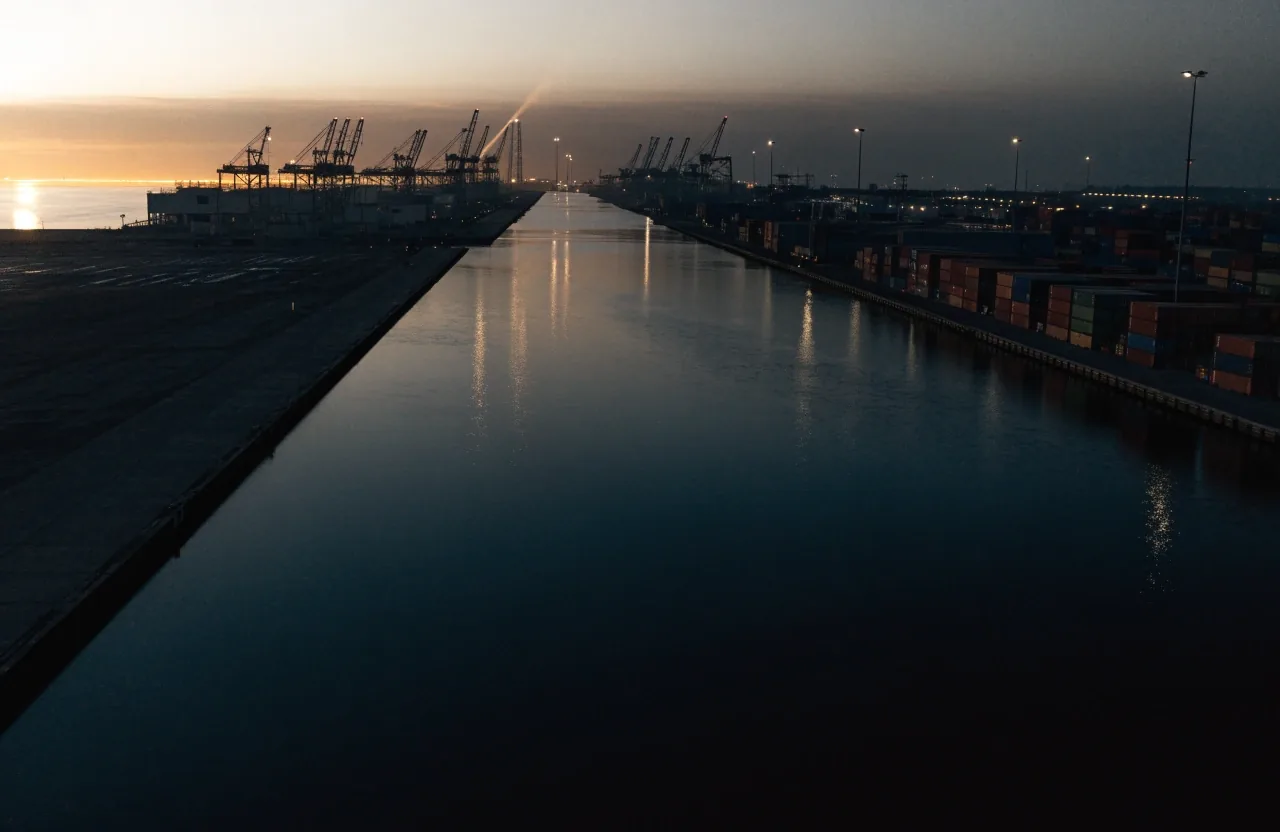
Gulf port approach channel at dusk with cargo cranes in deep shadow and warm light on the horizon

Strait of Hormuz · transit conditions

How this connects to shipping

The Strait of Hormuz carries a large share of the region's seaborne trade, so transit conditions there sit underneath the oil-price story. Iran and Oman finalized coordinates for designated safe transit routes through the strait, with the coordinates to be shared with the relevant international maritime body.

Safer routing reduces uncertainty, and markets price uncertainty before they price events. A published corridor does not remove the geopolitical risk, but it does give carriers and underwriters a defined path to quote against — and a defined path is easier to insure than an open question.

Read the Hormuz shipping story

Charted but uncertain

Fiscal pressure alongside the oil price

Fiscal worries appeared in the same Reuters report as high oil prices, which is unusual to read together. Higher crude raises revenue expectations for producing states while widening import costs for everyone else.

When both pressures are active at once, market sentiment can turn negative even with oil trading high. In a region where several economies run large import bills alongside their export revenue, the two lines on the ledger move in opposite directions at the same moment. That is the part of the story a simple "oil up, region up" read misses.

For producing states

Revenue expectations rise with the crude price, which supports the fiscal picture over the medium term.

For importers

The same price raises the cost of everything bought in, from fuel to feedstock, and that shows up in the trade balance.

Read together

Both active at once is why sentiment can sour while the headline commodity is trading high.

What UAE readers should take from it

For readers in Dubai and Abu Dhabi, the practical read is that regional security signals are now working through local benchmarks alongside global pricing. The UAE stock story from 2 October 2026 is the local expression of the same mood.

Two habits make this easier to follow. First, check whether a move originated abroad or in the region — the same percentage can mean very different things depending on its source. Second, read the shipping and security coverage next to the market coverage; when transit conditions change, freight and insurance costs follow, and those reach company results with a delay of weeks rather than days.

Freshly installed street sign post and blank marker plates on a Gulf city corner at golden hour
UAE addressing and signage work moves on its own schedule, separate from the pricing story but part of the same urban read.

Our own limits

What we do not claim

We are not forecasting oil prices, and we are not projecting where Gulf indices go next. This report collects what Reuters published on 7 October 2026, attributes it, and connects it to the regional developments our desk is covering.

Where a figure is absent, we leave it absent rather than estimating. That rule costs us some of the texture a modelling piece would carry, and it is the reason every number on this page can be traced back to a named source and a date.

Where the numbers come from

  • Named wire reports

    Each market claim on this page carries its publisher and its publication date.

  • Regional developments

    Shipping and security items are linked to the desk's own coverage rather than restated in passing.

  • Nothing estimated

    Where a figure is not published, the slot stays empty rather than filled with a rounded guess.

How we verify

Following the story

The market, shipping and regional threads are tracked across Markets, Economy, Security and Middle East. The weekly briefing pulls them together so a change in one strand is visible alongside the others. If you follow Gulf markets, the Economy and Markets pages are the place to start.

Where each thread lives

Markets Benchmarks, sessions and the price of uncertainty Covering
Economy Fiscal pressure, trade balances and the local session read Covering
Shipping Transit routes, insurance and freight costs Covering
Energy demand Not yet

We print the gap rather than filling it. Where we have not reported a thread, the row stays blank until the desk has something sourced to put in it.

Markets Economy Transport & Urban Technology & Mobility

Questions readers ask

Short answers to the two things most often asked when a story like this moves. If your question is about a specific holding or position, our desk cannot answer it — that is outside what this newsroom does.

What caused the market move?

Reuters linked it to high oil prices and fiscal worries, with supply constraints including storm risks in North American oil regions and Houthi attacks on Saudi Arabia.

Is NavigationInf forecasting oil prices?

No. We report what named sources published and attribute it with dates. Nothing on this page should be read as a price target, a trade recommendation, or a view on where any index goes next.

Why does the same price move get described two different ways?

Because two different constraints are pushing on it. A storm in a distant producing region and a security incident next door both raise the same headline number, but they carry different durations and different risk premiums. Reading which one is active tells you more than the number itself.

Where to go next if you follow Gulf markets

Start with the Markets section for benchmarks and sessions, and the Economy section for the fiscal side of the same story. The shipping thread lives in its own report on the Strait of Hormuz corridors. If you would rather have the week assembled for you, the weekly briefing carries the changes across all three in one place.

Coverage questions, corrections and story tips reach the desk through the contact page. Our editorial standards page explains how sourcing, attribution and corrections work at NavigationInf, and it is the right place to check before you rely on anything we publish.

NavigationInf · Office 402, Al Thuraya Tower 1, Dubai Media City, P.O. Box 500001, Dubai, UAE · +971 4 391 2244 · Monday to Friday, 9:00 AM – 6:00 PM